

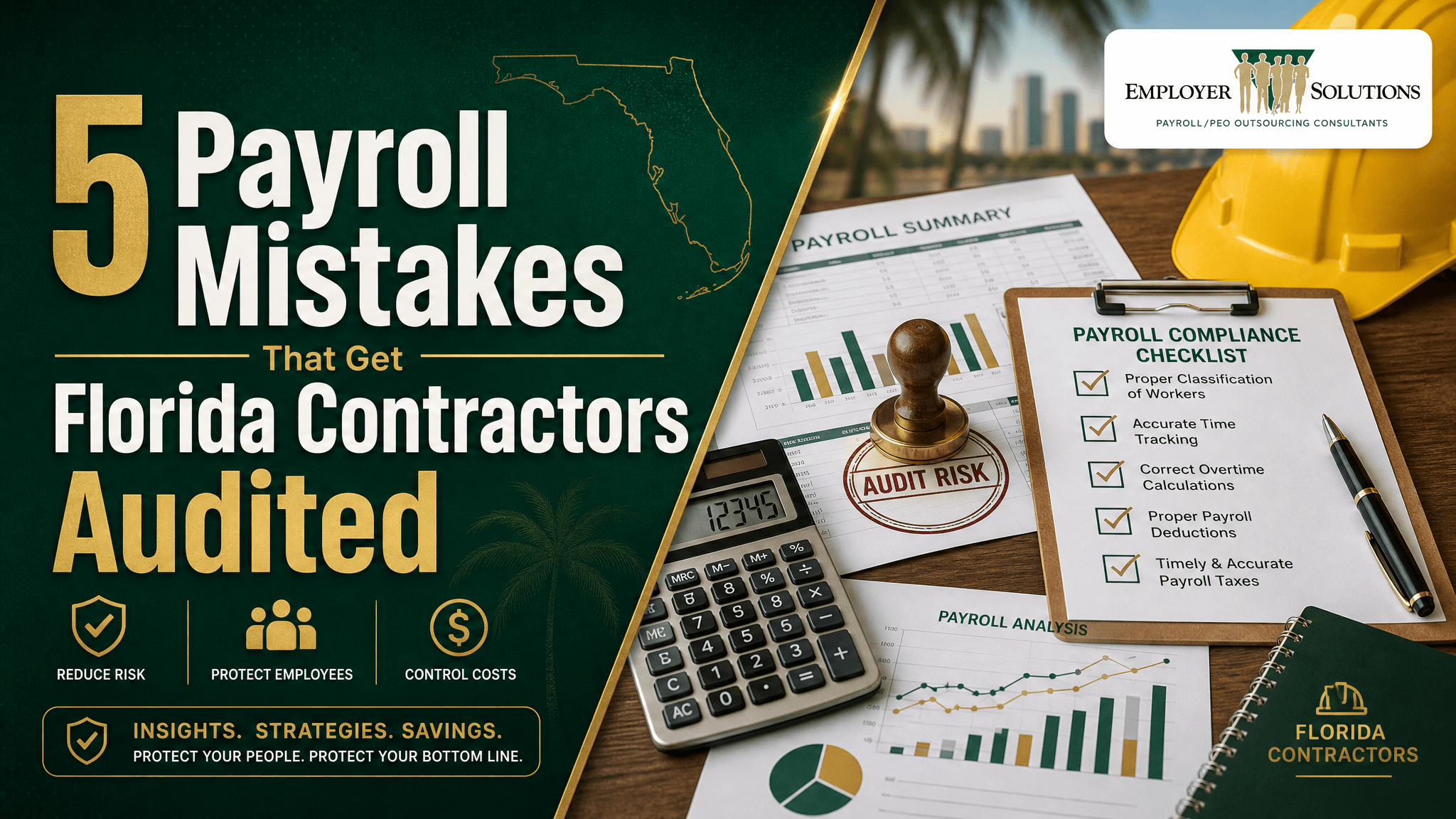
5 Payroll Mistakes That Get Florida Contractors Audited
For Florida contractors, payroll problems rarely start with a formal audit. They start with records that do not quite match the way the business actually runs.
A job gets added late. A worker gets paid the wrong way. A subcontractor file is missing a certificate. Time records do not line up with project totals. Then, when someone reviews the books, the inconsistencies show up all at once.
That is why payroll discipline matters so much in project-based work.
1. Mixing employee and subcontractor treatment
This is the mistake that causes the most trouble.
If a person is functioning like an employee but is paid like a contractor, the file becomes vulnerable quickly. The risk is not just tax reporting. It can also affect unemployment, workers’ compensation, and wage issues.
Contractors need a clear rule for who is truly independent and who belongs on payroll.
2. Letting job records drift away from payroll records
For contractors, the story told by job files should match the story told by payroll.
If labor is being assigned to projects, the labor detail has to be clean. If one system says a worker spent time on field work and another says admin, the audit trail gets muddy fast.
That matters because auditors look for consistency. When the numbers and the job records disagree, questions follow.
3. Paying people off the books or outside the normal process
Manual payments, cash payments, and one-off exceptions create risk because they are easy to forget later.
A business may think the payment was harmless because it was small or temporary. But small exceptions have a way of stacking up. If the records are not complete, the business has to reconstruct them later.
Clean payroll usually means every person and every payment follows the same basic process.
4. Missing subcontractor paperwork
If a contractor hires subcontractors, the file needs more than an invoice.
A strong subcontractor record usually includes a signed agreement, a W-9, insurance documentation, and enough detail to show the worker is operating independently. Without that support, the company may have a harder time defending its treatment of the relationship.
When paperwork is missing, the risk can shift from the subcontractor file back onto the business.
5. Waiting until quarter-end to reconcile everything
Quarter-end is when contractors often discover problems they could have caught weeks earlier.
If payroll, deductions, reports, and project totals are only compared at the end of the quarter, mistakes have more time to spread. That can mean amended filings, cleanup work, and a longer audit trail.
A short monthly reconciliation is usually much safer than a big quarterly scramble.
Why audits often start with a simple mismatch
Most audits do not begin with a dramatic event. They begin with a mismatch.
Maybe a form shows one thing and a payroll record shows another. Maybe a subcontractor was treated differently from one job to the next. Maybe labor totals do not support the way the company filed the work.
The audit itself is often just the moment when the mismatch becomes impossible to ignore.
What Florida contractors should tighten now
If you want to reduce audit risk, start with the basics:
- classify workers by actual working relationship
- reconcile payroll to job records monthly
- keep subcontractor files complete and current
- stop using ad hoc payment methods unless they are fully documented
- review tax filings before they go out
- make sure payroll, accounting, and project managers are looking at the same numbers
Those steps do not just help during an audit. They make the whole business easier to run.
A practical audit-ready habit
One of the best habits is to ask a simple question every month: if someone reviewed this file tomorrow, would the payroll story make sense without a lot of explanation?
If the answer is no, the business probably needs a cleanup pass now instead of later.
What this really protects
Clean payroll is not just about avoiding penalties. It protects margins, keeps projects moving, and makes the company less vulnerable when a regulator, insurer, or client asks for proof.
For Florida contractors, that kind of readiness is a business advantage.
Why the audit trail matters
When the file is organized, you do not have to rebuild the story from memory. That saves time, lowers stress, and makes it easier to answer questions quickly if someone asks for support on a project, a worker, or a filing.
Employer Solutions PEO can help review contractor payroll, tighten classification, and build a cleaner recordkeeping process before a small issue turns into a larger audit problem.





Leave A Comment