

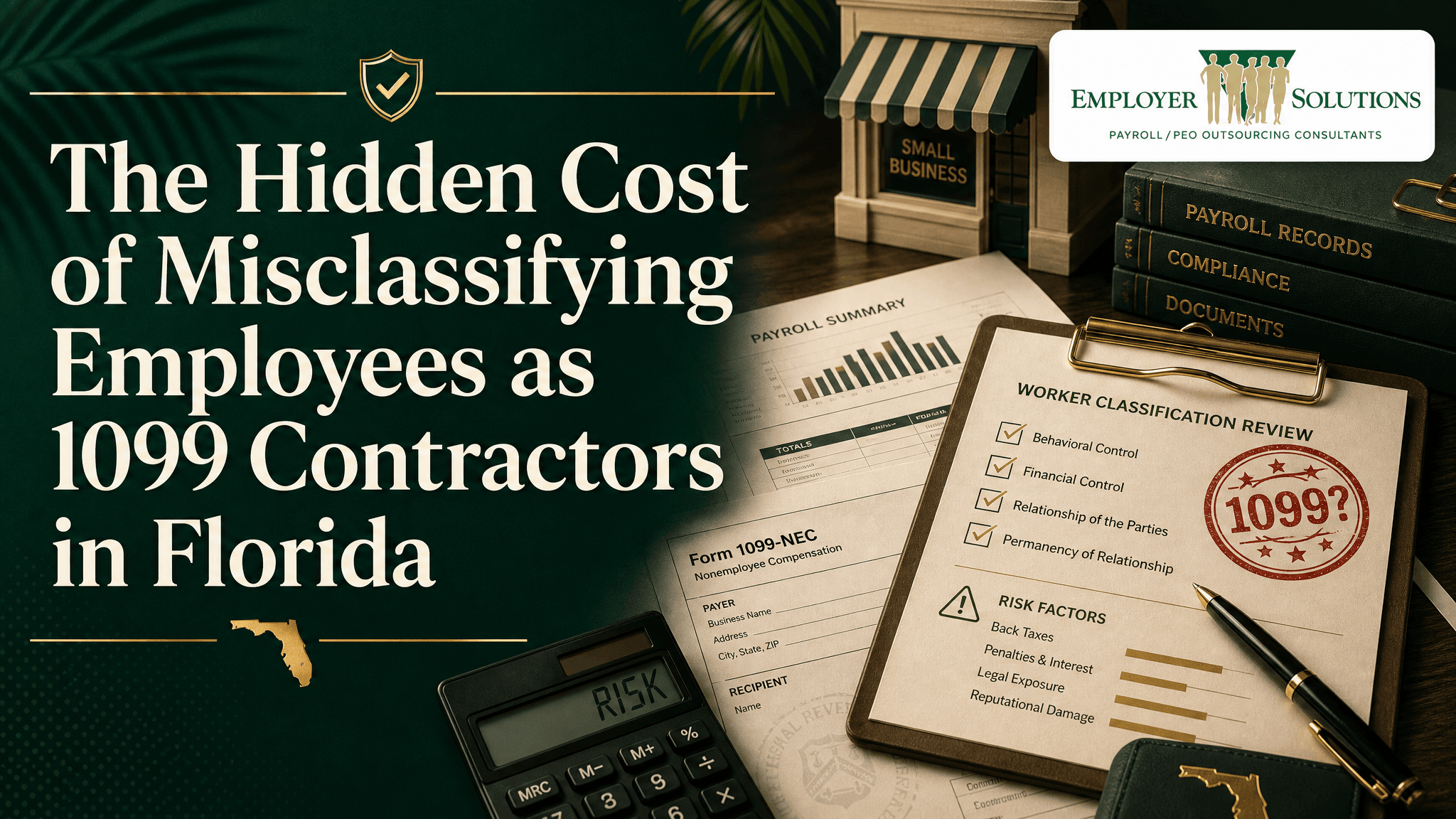
The Hidden Cost of Misclassifying Employees as 1099 Contractors in Florida
Misclassifying a worker as a 1099 contractor can look harmless at first. It may even feel efficient. You avoid payroll taxes, benefits administration, and some of the routine paperwork that comes with employees.
But the savings are often temporary. If the actual working relationship looks more like employment, the costs can come back later as tax corrections, wage issues, insurance problems, and audit headaches.
The title on the invoice does not decide the classification
A worker is not a contractor just because the business calls them one. What matters is the facts of the relationship.
The main question is control: who sets the schedule, who directs the work, who supplies the tools, how the person is paid, whether the person can work for others, and whether the work is part of the company’s regular business.
If the arrangement looks employee-like, calling it a contractor relationship does not make the risk go away.
Why Florida businesses get tripped up
Florida companies often use contractors in construction, home services, sales, delivery, creative work, and project-based work. That is normal. The problem is when a business starts using the same contractor setup for someone who is really functioning like staff.
That usually happens when:
- the company controls the day-to-day schedule
- the person works only for one business
- the person uses company tools or systems all day
- the work is integrated into normal operations
- the relationship keeps going long after the original project ended
That is when a review becomes important.
The hidden costs show up in more than one place
Misclassification does not just affect payroll. It can create exposure across several systems at once:
- back payroll taxes and filings
- unemployment issues
- wage and hour claims
- workers’ compensation questions
- insurance and recordkeeping problems
- penalties, interest, and administrative cleanup
If the relationship is challenged, the correction can be messy because multiple records have to line up.
Why the mistake is easy to miss
Businesses usually do not misclassify workers because they want trouble. They do it because the working relationship changed gradually.
Maybe the contractor started on a short project and stayed on for months. Maybe the person began as independent and then got folded into the daily schedule. Maybe the team grew fast and never revisited the original setup.
That drift is what makes periodic reviews so important.
What the facts usually look like when the risk is high
A contractor relationship deserves a second look when the business controls a lot of the details:
- where the work happens
- when the work happens
- how the work is performed
- what tools are used
- whether the person can hire helpers
- whether the person can take other clients
- whether the work is billed like a business service or managed like a shift
No single factor always decides the issue. The full pattern matters.
The cleanup can be bigger than the savings
If a worker should have been treated as an employee, the company may have to unwind a lot of things.
That can mean:
- correcting payroll history
- reviewing tax withholding and filings
- addressing overtime or wage claims
- fixing insurance and workers’ comp records
- revisiting benefits treatment
- documenting the correction for future audits
The financial hit is one part. The time cost is the other. Both can be significant.
How to reduce the risk now
The safest move is to review the actual relationship, not just the contract.
Ask:
- Is the worker running a separate business?
- Does the worker control how the job is done?
- Does the worker have real independence on schedule and clients?
- Is the work ongoing in a way that looks like normal staffing?
- Are the records consistent with the relationship we say we have?
If the answers are fuzzy, the arrangement probably needs a closer look.
Fix the relationship before the record creates the problem
If a contractor should be an employee, it is usually better to correct the setup early rather than wait for an audit or claim to force the issue.
That may mean changing the pay structure, updating the file, or shifting the worker into payroll. What matters is that the paperwork matches the real-world relationship.
For businesses with recurring project labor or mixed employee/contractor teams, a regular classification review is worth the time.
Florida-specific caution
This is one area where good-faith assumptions are not enough. Florida businesses should look at the actual facts, keep clean documentation, and get help when the relationship is close to the line. If you are unsure, a payroll, HR, or legal review is smarter than guessing.
The cheapest contractor arrangement is not the one with the lowest invoice. It is the one that still makes sense after the facts are checked.
Employer Solutions PEO can help Florida businesses review worker classification and build a cleaner payroll structure before a small mistake becomes a larger one.




Leave A Comment